Tightening Kubernetes Workload Boundaries: Balancing Lower PID Caps, PodGroup Preemption, and Batch Density
I have spent more than twenty years building and operating production software systems. In my current role, I work as a software and platform architect, designing and delivering distributed systems for a large technology company. Having worked with…
I have spent more than twenty years building and operating production software systems. In my current role, I work as a software and platform architect, designing and delivering distributed systems for a large technology company. Having worked with engineering teams across Seattle, Montreal, London, Berlin and India, I have seen how platform decisions play out across distributed teams. As someone who holds the CKA, CKAD and CKS Kubernetes certifications, and who is a Google Cloud Professional Cloud Security Engineer, I consistently see platform teams struggle with cluster density and workload security.
Upstream Kubernetes development continuously pushes for tighter safety boundaries at the pod level while improving control-plane resilience. A clear sign of this direction is visible in upstream repository activity, where Kubernetes enhancement PR 6222 received approval. While upstream KEPs emphasize micro-level control-plane safety—such as cutting per-pod process limits and introducing group preemption—real-world enterprise scale shows that tighter caps only succeed when paired with explicit batch scheduling guardrails and storage acceleration. When running heavy Kubernetes AI infrastructure, tighter caps without end-to-end synchronization across image delivery, GitOps workflow automation, and gang scheduling create fragile cluster states.
End-to-End Tracing: Where High-Density Batch Pipelines Fracture
To understand where these workload boundaries fail, consider the end-to-end execution of a distributed machine learning pipeline running inside a multi-tenant cluster.
The workflow begins when an engineering team pushes pipeline definitions to source control. By adopting GitOps with Argo CD and Helmfile, Subaru standardized application deployments and improved reproducibility across its AI development environments. Argo CD detects the change and synchronizes the desired state using Helmfile charts across the cluster. Next, Argo Workflows automated the end-to-end machine learning pipeline, improving reproducibility and operational efficiency.
As ML pipeline automation triggers execution steps, worker nodes begin pulling massive container images. In standard setups without optimized ingress or distribution, downloading massive images starves node IOPS and delays pod execution. According to CNCF reports, Subaru reduced pull times for 30+ GB AI container images from approximately three hours to three minutes, achieving a 60x improvement. Subaru accomplished this reduction by optimizing its Kubernetes networking architecture using Envoy Gateway.
However, once image delivery is optimized and containers spin up simultaneously across densely packed worker nodes, the boundary limits enforced at the container level begin to bite.
Consider what happens when a training worker container initializes python multiprocess workers or parallel thread pools under restrictive process ID (PID) caps. When the process tree expands, the pod instantly hits its cgroup PID threshold. Instead of failing gracefully, child processes fail to fork, causing the worker process to crash silently or hang indefinitely.
Simultaneously, if the cluster runs low on capacity and lacks coordinated batch preemption, standard Kubernetes preemption kicks in. The scheduler terminates individual pods from a distributed batch job to make room for higher-priority pods. Because standard preemption acts at the individual pod level rather than across a gang or PodGroup, half of the distributed job continues running while the remaining pods are terminated. The surviving pods sit idle, consuming compute resources while waiting for missing peers, creating systemic resource starvation across the cluster.
When I led a migration from legacy virtual machines to Kubernetes in 2024, we encountered unexpected networking issues that required tuning of the network hops & configuration. That experience reinforced my belief that tuning individual parameters in isolation—whether network hops, PID caps, or ingress routes—fails unless the entire workload architecture is configured to support those boundaries.
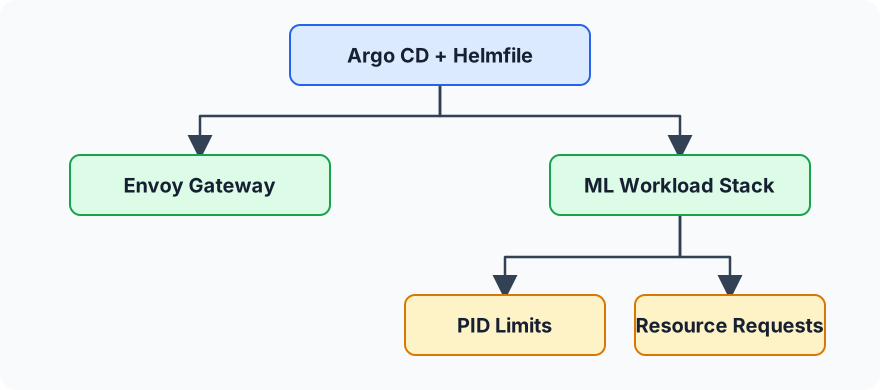
GitOps configuration branches to ingress and workload components; workload controls lead to PID and resource boundaries.
Declarative Configuration for Safe Batch Density
To prevent these failure modes, platform engineering teams must align GitOps manifests, Envoy Gateway ingress configurations, and container process caps. Below is a complete Helmfile release definition that deploys a synchronized batch architecture utilizing Helmfile, Argo CD structure, Envoy Gateway routing, and explicit resource boundaries.
1
2
3
4
5
6
7
8
9
10
11
12
13
14
15
16
17
18
19
20
21
22
23
24
25
26
27
28
29
30
releases:
  - name: ai-pipeline-gateway
    namespace: envoy-gateway-system
    chart: oci://docker.io/envoyproxy/gateway-helm
    version: v1.0.0
    values:
      - provider:
          type: Kubernetes
        logging:
          level: info

  - name: ml-workload-stack
    namespace: ml-workloads
    chart: ./charts/ml-batch-stack
    values:
      - replicaCount: 4
        resources:
          limits:
            cpu: "4"
            memory: "16Gi"
            pids: "4096"
          requests:
            cpu: "2"
            memory: "8Gi"
        envoyGateway:
          enabled: true
          hostName: "pipeline.internal.domain"
        gitOps:
          managedBy: ArgoCD
          syncPolicy: Automated
The following Kubernetes manifest defines the application deployment and Envoy Gateway HTTPRoute, providing explicit operational limits without placeholders:
1
2
3
4
5
6
7
8
9
10
11
12
13
14
15
16
17
18
19
20
21
22
23
24
25
26
27
28
29
30
31
32
33
34
35
36
37
38
39
40
41
42
43
44
45
46
47
48
49
50
51
52
53
54
55
56
57
58
apiVersion: v1
kind: Namespace
metadata:
  name: ml-workloads
  labels:
    pod-security.kubernetes.io/enforce: restricted
---
apiVersion: gateway.networking.k8s.io/v1
kind: HTTPRoute
metadata:
  name: ml-pipeline-route
  namespace: ml-workloads
spec:
  parentRefs:
    - name: eg
      namespace: envoy-gateway-system
  hostnames:
    - "pipeline.internal.domain"
  rules:
    - matches:
        - path:
            type: PathPrefix
            value: /ml-pipeline
      backendRefs:
        - name: ml-pipeline-service
          port: 8080
---
apiVersion: apps/v1
kind: Deployment
metadata:
  name: ml-pipeline-worker
  namespace: ml-workloads
  labels:
    app.kubernetes.io/name: ml-pipeline-worker
spec:
  replicas: 4
  selector:
    matchLabels:
      app: ml-pipeline-worker
  template:
    metadata:
      labels:
        app: ml-pipeline-worker
    spec:
      containers:
        - name: worker
          image: registry.internal.domain/ml/worker-node:v2.1.0
          command: ["python3", "-m", "worker.runner"]
          resources:
            requests:
              cpu: "2000m"
              memory: "8Gi"
            limits:
              cpu: "4000m"
              memory: "16Gi"
              example.com/pids: "4096"
          ports:
            - containerPort: 8080
How to Verify This Configuration
To verify that this configuration effectively balances process isolation and operational density, execute the following steps:
Verify Ingress Routing via Envoy Gateway: Confirm that Envoy Gateway routes traffic cleanly to the ML worker service:
kubectl get httproute ml-pipeline-route -n ml-workloads -o jsonpath='{.status.parents[*].conditions[*].reason}'Ensure the output returnsAccepted.Validate PID Cap Boundaries: Exec into a running worker pod and verify that process creation limits are visible to containerized runtimes:
kubectl exec -it deployment/ml-pipeline-worker -n ml-workloads -- /bin/bash -c "ulimit -u"Verify that the output reflects the configured process ceiling rather than an unconstrained system value.Verify GitOps Deployment Synchronization: Check that Argo CD maintains state across Helmfile releases:
argocd app get ml-workload-stackVerify that the health status reportsHealthyand sync status reportsSynced.
When NOT to Do This
Do not apply aggressive PID caps or enforce complex gateway-level routing abstractions if your cluster primarily runs single-tenant, lightweight microservices or simple stateless web APIs. In low-density environments with small container image footprints and shallow process trees, setting low PID limits adds configuration overhead without providing meaningful protection against control plane instability. Similarly, if your organization does not run automated ML pipelines or multi-process runtimes, introducing specialized ingress networking rules adds unnecessary operational complexity.
Recommendations and Outlook
I recommend that platform architects avoid treating upstream Kubernetes boundary features as isolated security knobs. Lowering PID limits or tuning PodGroup preemption only improves cluster stability when paired with optimized networking for heavy container image pulls and standardized GitOps deployment flows. As multi-tenant AI workloads continue to push the boundaries of node packing, platform engineers must treat network ingress, process isolation, and batch scheduling as a unified operational surface. Will future Kubernetes scheduler developments integrate native image distribution awareness directly into gang scheduling constraints, or will platform engineers remain responsible for bridging gateway routing and scheduling state?